
Nanda Devi is more than just a name in Uttarakhand — she is a living deity, revered as a mother and protector across the sacred terrain of Devbhoomi. Her presence is deeply embedded in the cultural and spiritual fabric of the region. Towering at 7,816 metres, the majestic Nanda Devi peak dominates the skyline, often visible from distant ridgelines. To the east, she is flanked by her sister peak, Sunanda Devi (or the Nanda Devi East), rising to 7,434 metres.
A hidden fortress of the Goddess
Before the 19th century, Nanda Devi peak remained untouched – a sacred and inaccessible land, surrounded by a formidable ring of mountains. It was believed that this natural fortress shielded the divide abode of the mother Goddess. Entry into the inner sanctuary was virtually impossible.
The British Encounter | Use of new scientific instruments
The Great Trigonometrical Survey (GTS) was an ambitious scientific and cartographic undertaking of the 19th century, undertaken by the Survey of India. The British surveyors of the GTS began observing the Nanda Devi peak from distant stations between the period 1808 – 1840. Sir George Everest was the Survey General of India during the period. Many people attempted to reach the peak, but it was impossible to get into the inner sanctuary of the Nanda Devi region.
The first ever documented attempt to access the Nanda Devi Inner sanctuary was made by Dr Tom Longstaff during his 1905 expedition. He took the route via Munsyari (from the Kumaon side), onwards to the Milam valley, and then went westwards into the Lawan valley. From here, he possibly climbed the Lawan Glacier, on top of which is a narrow, icy pass called the Longstaff Col. This gave him a clear view of the inner sanctuary, as on one side of the col lies the Nanda Devi East (Peak II). However, the tough terrain and difficult weather forced him to abandon any further exploration, and it was eventually a dead-end to enter the inner sanctuary via this route.
In 1934, Eric Shipton and H.W. Tillman, accomplished British explorers, succeeded in entering the inner sanctuary via the Rishi Ganga gorge (from the Garhwal side). This area/route falls in the Chamoli district, a short detour from the Niti Valley, at the village Raini, where the Rishi Ganga meets the bigger Dhauli Ganga river. Finally, on 29th August 1936, H.W Tillman and Noel Odell successfully summited the Nanda Devi (peak I, 7816). Until 1950, when Annapurna eventually was summitted, it continued to be the highest climbed peak in the world. Mount Everest was first summitted in the year 1953.
Since 1988, this region has been a recognized biodiversity hotspot, acknowledged under the UNESCO conservation protocols and charter. The inner sanctuary and the adjoining area, the core zone, is part of the Nanda Devi National Park (NDNP).


As an avid trekker, I have explored several trails across Uttarakhand – both in the Kumaon and Garhwal regions – and have been fortunate to witness the spectacular vistas of this towering peak from multiple angles. Owing to its sheer height and its orientation along the Northwest-Southeast (NW-SE) axis, Nanda Devi reveals its grandeur from numerous high points across both regions. This geographical prominence is one key reason why she resonates deeply with the people of Uttarakhand, whether Kumaonis or Garhwalis.
Nanda Devi | Deeply rooted in the essence of Uttarakhand


Numerous temples dedicated to Nanda Devi exist across Uttarakhand. The more prominent ones are:
a) The Nanda Devi Temple at Nauti Village (Chamoli district – Garhwal region), from where the Raaj Yatra originates.
b) The Nanda Devi Temple at Almora (Almora district – Kumaon region).
c) The Nanda Devi Temple at the picturesque hill station of Munsyari (Pithoragarh district – Kumaon region).
d) The Nanda Devi (or Parvati) temple at Bedni Bugyal -enroute to Roopkund (Chamoli district – Garhwal region)
If you wish to read my dedicated post on the Nanda Devi temple at Nauti village – click here
The Kumaon region was ruled for a long time by the Chand dynasty, and Nanda Devi was their Kuldevi (family or clan deity). These customs and traditions have therefore continued and strengthened over time. Each year, during the period of Nanda Ashtami (which falls in August/September), a grand procession takes place – known as the Nanda Devi Mahotsav. It originated in Almora, where the royal palace of the Chand dynasty was located, and continues to this day. Now, Nainital is also a prominent place to witness this festival. During the celebrations, idols of Nanda Devi and her sister Sunanda Devi, made of Cedar wood, are placed on a palanquin and carried through the town in a grand procession.

In Chamoli district, at Kurur village (near Karnprayag), the annual yatra (or the Nanda Devi Lok Jat) is observed in a more subdued form, usually ending at Bedni Bugyal. In Kumaon region, the annual Lok Jats takes place at several places including in the remote valleys of Pindar and Johar. However, once every 12 years, a grand Raj Jat (Yatra) takes place. This once-in-12-years yatra (also sometimes known as the ‘Himalayan Kumbh’) is scheduled to happen next year (2026). As part of the tradition, a four-horned ram is identified, and a procession of devotees accompanies the ram on foot all the way to Homkund, crossing difficult terrain including Roopkund, Junar Gali, and Sheela Samudra—a journey of over 280 km on foot, covered over a period of three weeks.

The ram is considered to be a divine representative or vehicle of Goddess Nanda Devi, who visits her ‘mait’ (maternal home) and, as part of this Raj Jat, is being accompanied back to her husband’s abode—Lord Shiva, who resides at Mount Trishul. It is believed that the Goddess travels spiritually through or with this ram during the yatra. As is the tradition in Uttarakhand, the village folk accompany her to ensure she reaches her husband’s place safely.
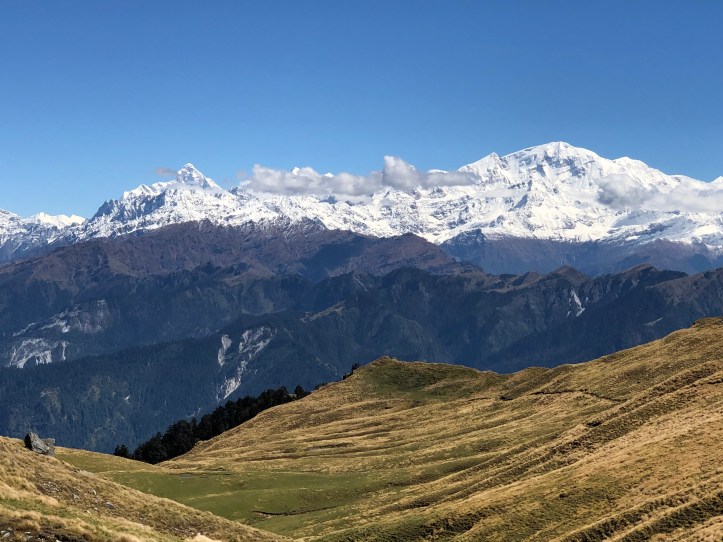
Nanda Devi, whether seen as a towering mountain peak or worshipped as a divine goddess , is a symbol of strength, grace and protection. Her presence is felt deeply across Uttarakhand, in its landscapes, its temples, and the hearts of its people. She is more than just a deity – she is a guiding force, a mother figure, to kinds, and the common man, and a source of peace and spiritual comfort for all who seek her blessings.
I hope you enjoyed the post. If you like my posts, I welcome you to subscribe to my blog page.
 Travel diaries from Uttarakhand
I enjoyed it very much Saurabh. Well researched and written. Didn’t know the complete background of summiting Nanda Devi.
Seems next year Himalayas will see the kumbh on its most expansive form.
I sat at Junargali last year for 10 minutes before walking back. I still feel of that afternoon nothing less than Darshan it was.
🔱
LikeLiked by 2 people
Indeed. Next year promises to be an exciting one in the upper reaches of Chamoli district. Wonderful to know, Narayan, that you trekked all the way to Junargali. Must have been an experience of its own. I am yet to travel beyond Bedni Kund, but if all goes well, may be I will tag along with the yatris next year. It’s a different feeling altogether when you are close to Mahadev, witnessing the grandeur of the majestic Trishul peak.
LikeLiked by 2 people
Saurabh, yes during my junargali walk the local boys really pressed that i should come for this. And i might. 12 years is a long time only to keep hearing about it.
It was all golden there when i was walking, i spent some time at Bedni kund too at Ma’s temple. A short quick nap on my way back as its a long long walk on that day from where i was allowed to camp. But Junargali was more, it was as i said darshan 🙂
But Roopkund lake had no Jala. So that was not only heartbreaking but alarming !
LikeLiked by 1 person