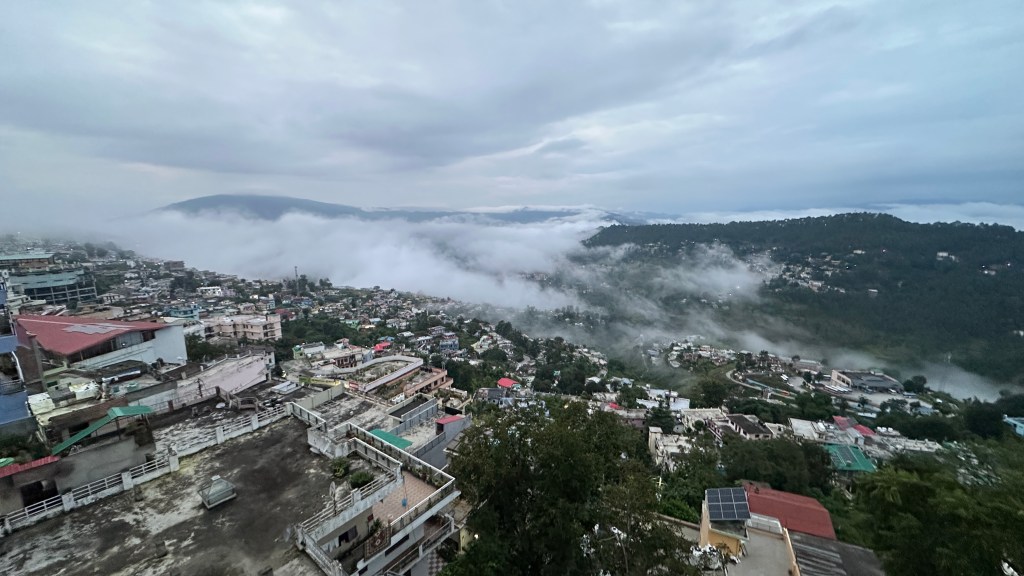
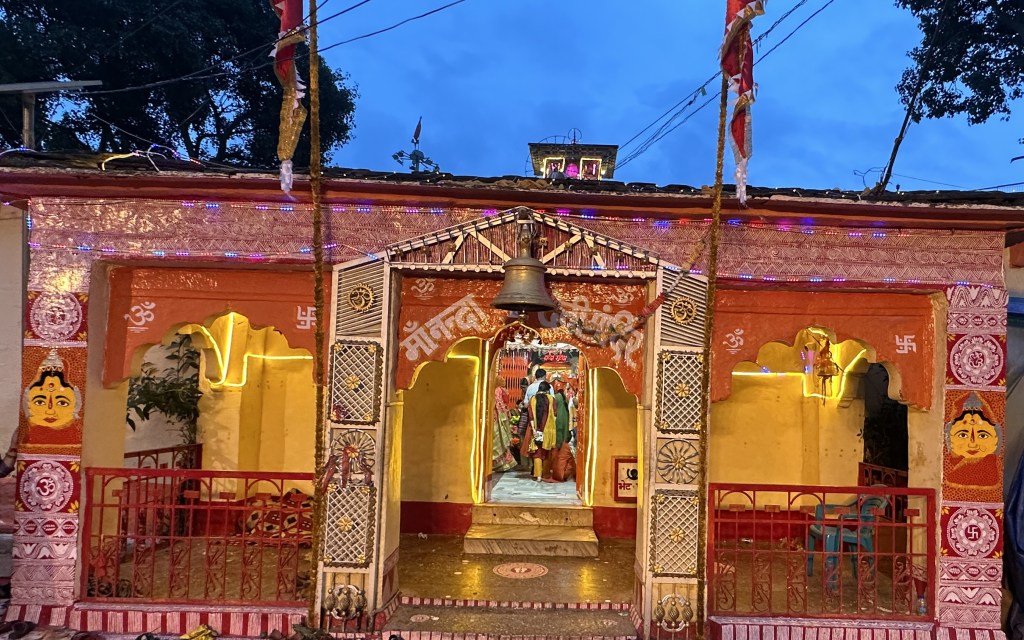
As I stand atop one of these higher mountains, witnessing the landscape unfold far and wide under an overcast sky, colourful settlements scattered across the green slopes of Pine, Oak & Deodar, the wind blowing heavily in the north-south direction, rubbing against my skin , teasing it awake, and leaving behind a tender chill as we usher in the hindu month of Bhado / Bhadra (day 7 of Shukla Paksha). The rhythmic tunes of the temple bells (at Maa Nanda Devi temple in Almora), further add to the milieu – a touch of spiritual splendour concocting the already electric atmosphere.
The name Nanda Devi echoes far & wide, when you travel these terrains in this part of the country. She is a living deity, a protector, and a mother to the people of this land – whether in the Garhwal region or Kumaon (read my dedicated post on this – click here). In this post, I take you on a sojourn to Almora to witness the Maa Nanda Devi Mahotsav, as the rain gods intermittently let loose their down power, pattering on the old rooftops, while nearby, an age-old tradition unfolds with equal fervour and devotion.

We are in day seven (7) , Shukla Paksha, of the Bhado month, and the temple premises are brimming with life — vendors shouting to make themselves heard, selling everything from toys and garments to special festival sweets. The main quadrangle is beautifully decorated for a series of folk performances; women are dressed deftly in their traditional and elaborate attire. Somewhere in the corner, soft rhythmic tunes emanate, and just outside the main sanctum sanctorum, the rituals have begun — freshly brought-in four (4) Kadali ( banana) tree trunks are being venerated as part of a tradition that has endured for ages.
Let’s rewind a few days, or perhaps weeks, and trace the journey of these banana trunks to the present day.
A few weeks or months before the Mahotsav each year, the temple committee makes enquiries in the villages adjoining Almora to identify households with flourishing banana trees and their willingness to contribute them for the rituals. This year, the committee decided to procure the trees from RailaKot village (google map link Village Location).
On Shashthi (the 6th day of the Bhado month), the temple committee members travel to the village. The entire community gather at the local temple to welcome the visitors, and a joint religious ceremony is held there. Following this, the delegation proceed to the earmarked Kadali trees, where a small pooja is performed in the presence of the household members who owns the trees. Four mature Kadali trees are identified – vermilion (tilak) , Akshat (Rice) are placed on their trunks, and a sacred chunni is tied around each of them. By sunset, the delegation begins its journey back to Almora.
The next day, Saptami, (the 7th of the Bhado Month), at the onset of dawn – before the sun rises over the horizon, the temple priests and the delegation, accompanied by much pomp and music, head back to Railakot village. With the symphony of the dhol and the bagpipes filling the air, the priests and the group head straight to the earmarked trees, again perform a short ritual before the identified Kadali trees are ceremoniously cut down to be transported back to the Maa Nanda Devi temple for the next set of sacred activities.
The journey back is an event in itself. As the procession enters Almora town, it visits each of the prominent temples — such as the Bhairav Temple and the Raghunath Temple — and winds its way through the main bazaars (Johri Bazar, Karkhana Bazar, Lala Bazar), drawing townsfolk into the spirit of this important annual ritual. By afternoon, the religious ceremonies commence.
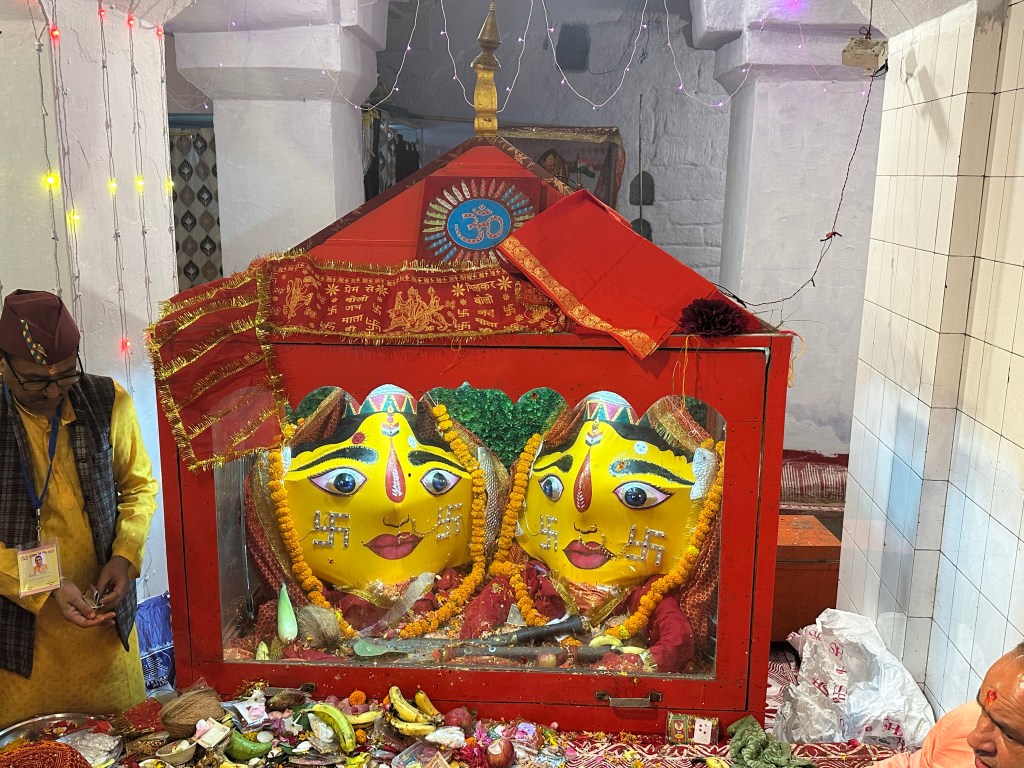
As per tradition, the key pooja rituals are conducted by the Chand lineage themselves — the present descendants now reside in Kashipur but travel to Almora for this occasion. Once the rituals begin, two of the four Kadali trees are identified for the next set of ceremonies. After the main rituals conclude, these two trees undergo an elaborate process through which the idols of Nanda and Sunanda Devi — the Kuldevi of the Chand dynasty — are carved.
The Chand rule in Kumaon and the Origins of the Maa Nanda Devi Temple in Almora
The Chand dynasty began its rule over Kumaon around the 12th century CE and continued until about 1790 CE. The capital was initially located in the Kali Kumaon region, at Champawat, and around 1563 CE, the then Chand ruler Kalyan Chand shifted the capital to Almora. Subsequent rulers governed from here, strengthening their authority and expanding their territory.
One of the most notable rulers, Raja Baz Bahadur Chand (who ruled between 1638 and 1678 CE), was a fierce warrior. He is said to have won the Battle of Badhan Garhi — fought against the Garhwal kingdom at Badhan Garhi, near present-day Gwaldam in Chamoli district. Location – google maps (location)
As Nanda Devi was the presiding deity of the temple at Badhan Garhi, the victorious king decided to bring the idols and a sword from that temple and install them in a new shrine within the Malla Mahal area of Almora, the seat of the Chand rulers.
According to local lore, while returning to Almora on the 7th day (Saptami) of the Bhado month, the royal contingent halted at the Kot Bhramari Temple near Garur (in present-day Bageshwar district), another highly revered shrine in the region. It is believed that the sword was inadvertently left behind at Kot Bhramari Temple (google map location), and the contingent returned to Almora the next day, on Ashtami (the 8th day) of the Bhado month. To commemorate this event, a large fair (mela) is still held every year at the Kot Bhramari Temple on Saptami (the 7th day) of the Bhado month.
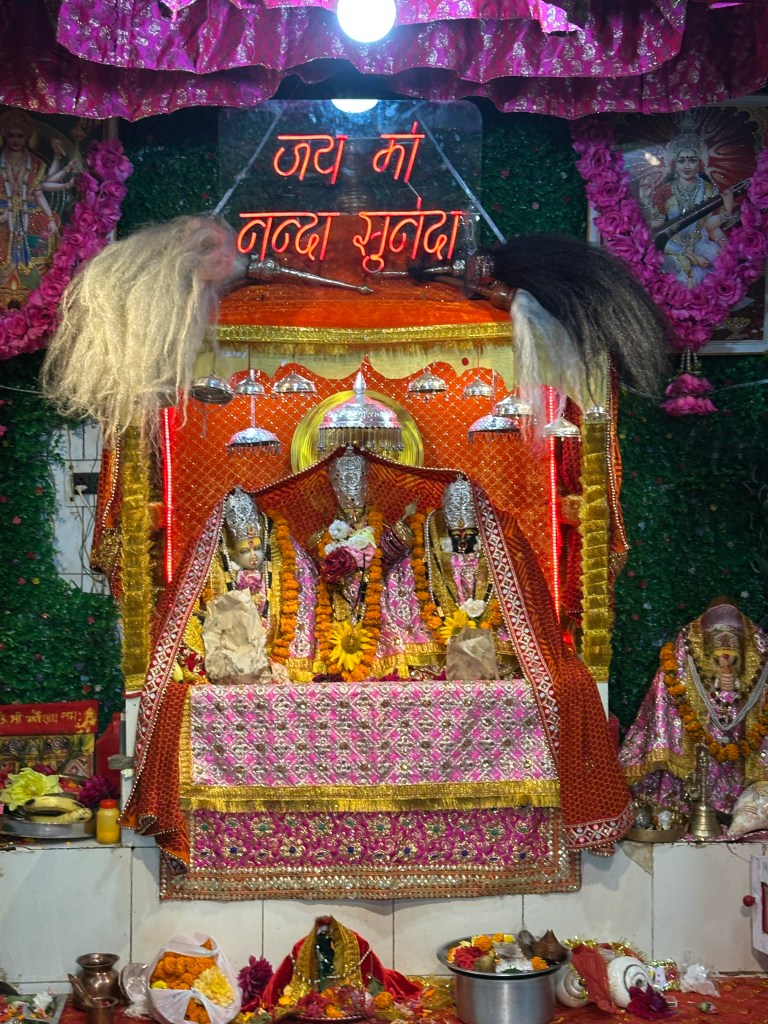
Raja Baz Bahadur Chand therefore installed the idols of Maa Nanda and Sunanda Devi at Almora and established the rituals that continue to be observed with deep devotion, nearly four centuries later. After the defeat of the Gorkhas in 1815, Kumaon came under British administration. The then Commissioner of Kumaon, George William Traill, ordered the demolition of the old Chand palace, the original temple, and associated fort structures, repurposing the area for British administrative use. It is believed that the Nanda Devi Temple was subsequently moved to the market area along Lala Bazaar Road in Dharanaula, where it stands today as one of Almora’s most revered landmarks. Location of the present site – Google Maps link
The Making of the Idols of Maa Nanda & Sunanda Devi

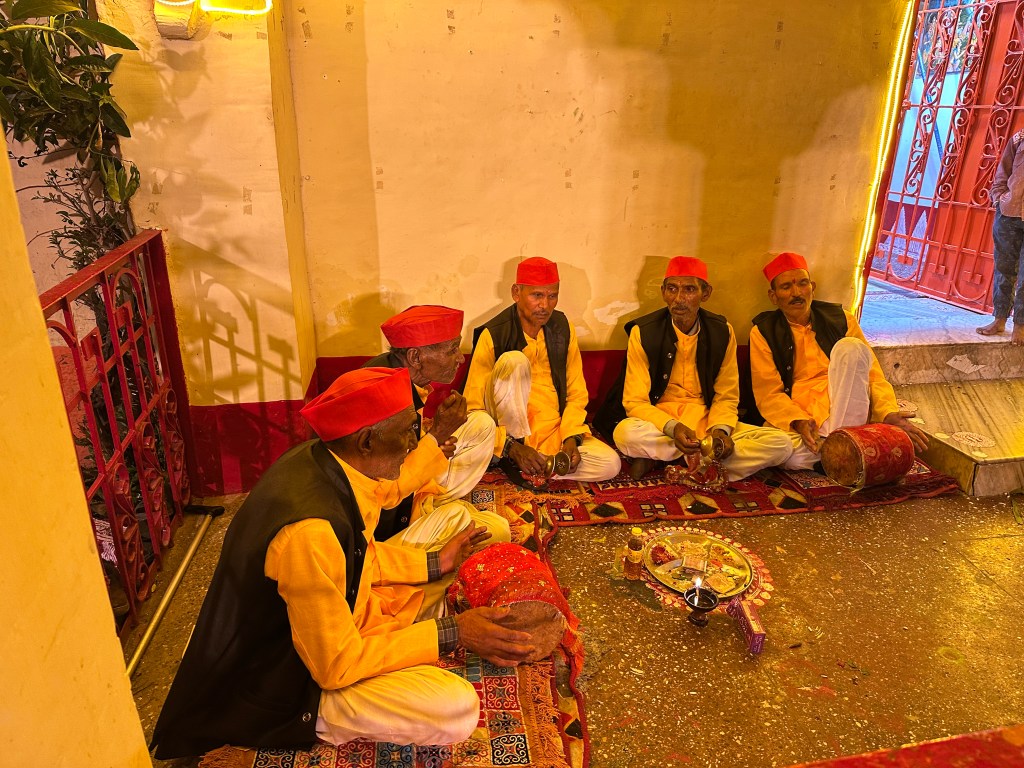
Having traced the temple’s origins, we fast forward to Saptami — the 7th day of the Bhado month. It is evening time. Folk performances fill the air with rhythm and colour, while skilled artisans gather inside the temple courtyard to begin crafting the intricately designed idols from the Kadali (banana) trunks. The sky is partly overcast, and streaks of orange twilight scatter across the horizon, bathing the scene in a gentle, sacred flame.


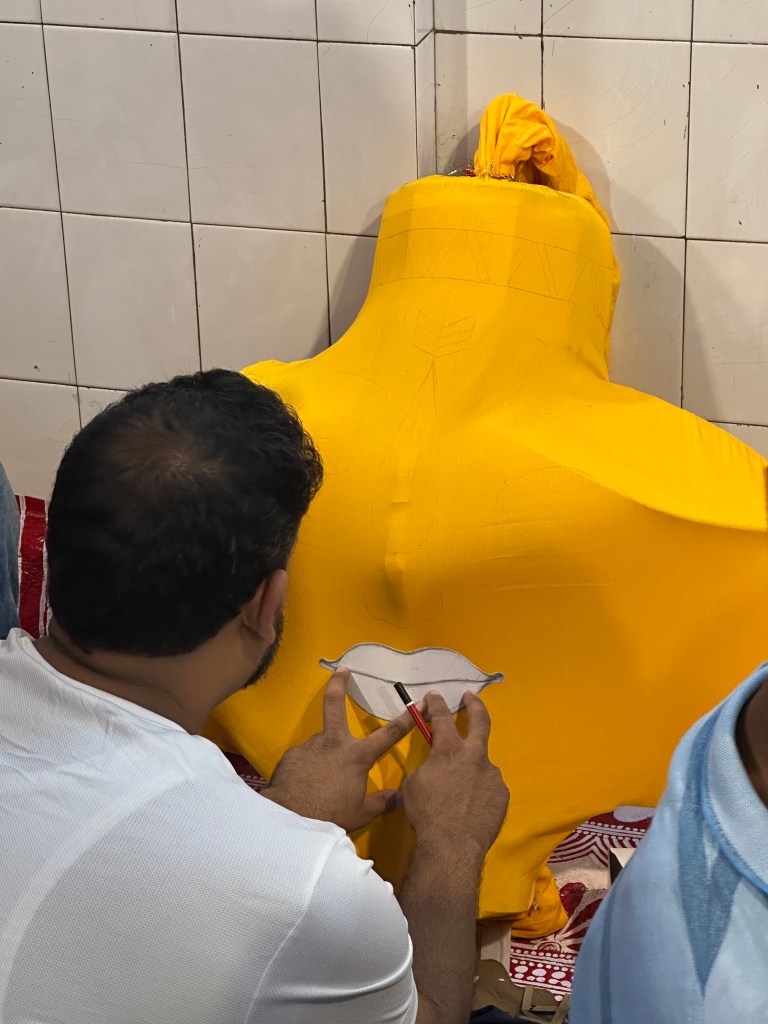
The artisans begin adorning the idols — a yellow cloth forms the base layer, symbolising purity and devotion. Over it, they add vibrant patterns and colours, each carrying a deeper meaning. The mukut (crown) signifies royalty and spiritual authority, while the white circular motif perhaps represents the moon, an emblem of the Chand dynasty (Chandravansh). The nath (nose ring) mirrors a quintessential ornament of Kumaoni women, linking the divine to the everyday. Finally, the two idols are encircled with a red drapery or Pichora, a traditional attire that embodies the divine feminine energy — Shakti.

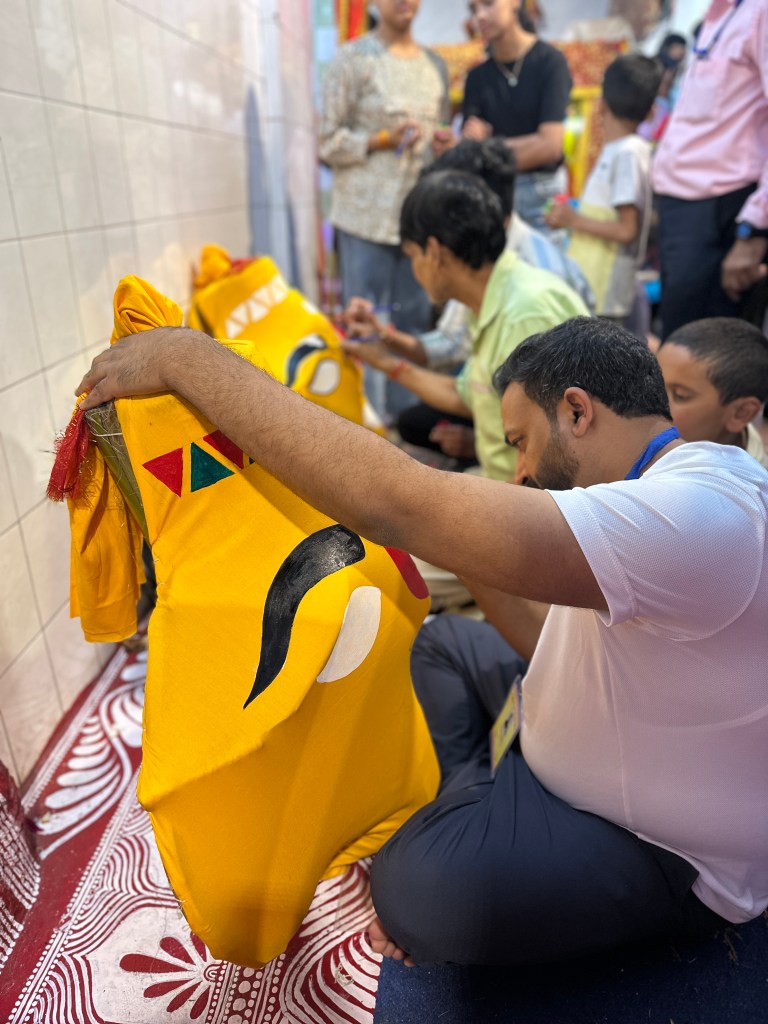
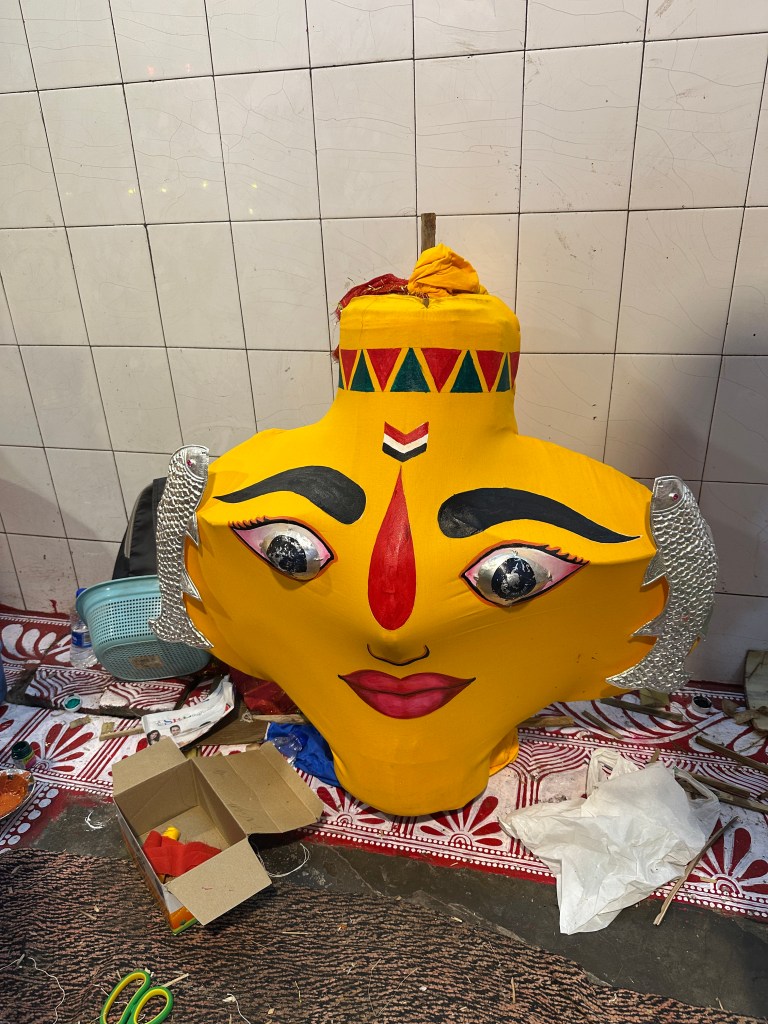
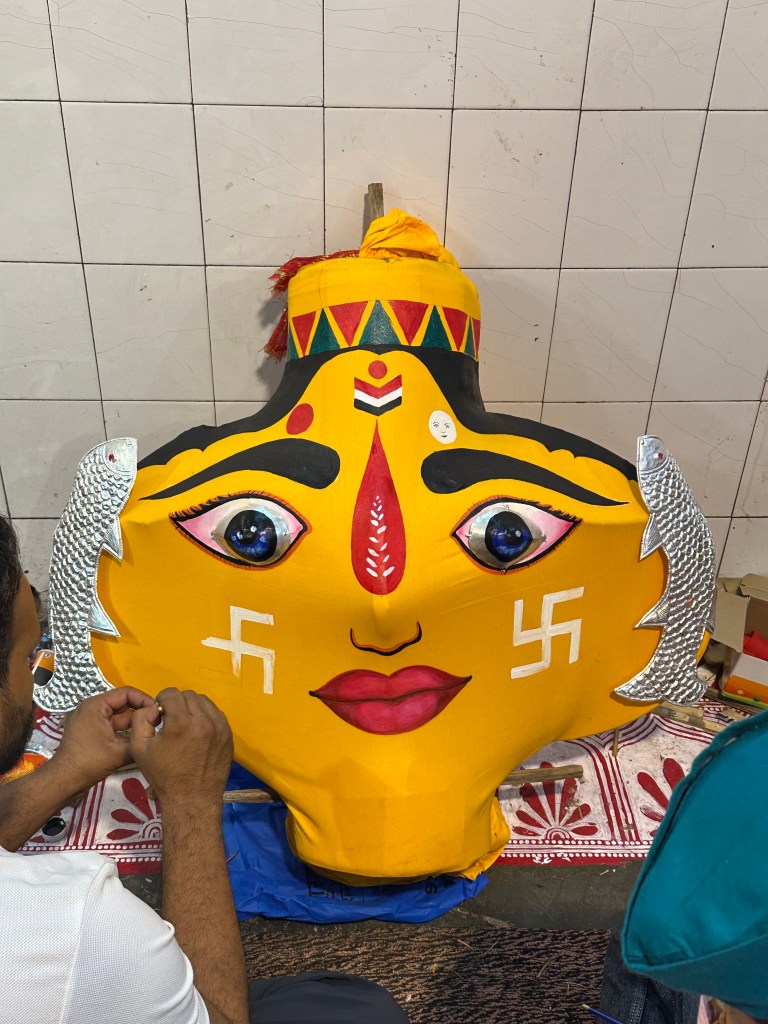
The skilled hands of these artisans work meticulously for nearly 7-8 hours, until the idols take their final, majestic form — seated gracefully upon a specially crafted palanquin (dola). Soon after, the royal family and temple priests arrive once again to perform the Pran Pratistha — the sacred ritual that infuses life into the idols. Following this solemn ceremony, the idols of Maa Nanda and Sunanda Devi are opened for public worship.

The most auspicious day of the Nanda Devi Mahotsav is Maha Ashtami (or Nandashtami), the eighth day (Shukla Paksha) of the Bhado month. From the early hours of dawn, devotees throng the temple to offer their obeisance and seek the Devi’s blessings. As evening descends, an elaborate royal Tantrik pooja is performed with deep solemnity and devotion. Ashtami traditionally marks the culmination of the Mahotsav, after which the idols — seated gracefully in their dola (palanquin) — are carried through the streets of Almora, before a symbolic closure takes place at a designated point in the town. The dola procession is considered sacred and is held only on Wednesday, Friday, or Sunday. Accordingly, the date of the procession is determined based on the day on which Ashtami falls that year.
Nanda Devi is a household name across Uttarakhand — revered by thousands and lakhs of devotees. Even among the mighty Himalayan ranges, two towering peaks bear her name – Nanda Devi (7,816 metres) and Sunanda Devi (7,434 metres)
The coming year, 2026, holds even greater significance. Once every twelve years, the sacred Nanda Devi Raj Jat — often called the Himalayan Kumbh — is taking place, and will cover several hundred kilometres (on foot) over a span of more than three weeks, from Nauti village to Homkund. Such is the enduring aura and divine power of the Goddess Nanda.
We come to the end of this post and I hope you enjoyed it.
 Travel diaries from Uttarakhand
Very important Essay and documentation Saurabh. I could feel the happiness in your presence there while also sensing the wait for the coming year.
I also thank you for providing vital details that most overlook that go into bringing whole villages and communities together to bring deities come to life.
Thank you.
LikeLiked by 2 people
Narayan – always great hearing from you. Glad you enjoyed it !! I know how deeply Almora and its rich traditions connect with you.
LikeLike
You really must publish, Saurabh, you are that good. Keep it up.
LikeLiked by 1 person
Glad you enjoyed reading it. and thank you for the compliment.
LikeLike
What a beautiful festival! Unlike festivals in cities which are merely holidays, this looks like a festival in true sense that connects and brings people together 🙂 thanks for taking us on this virtual journey, hope to see it in person someday.
LikeLiked by 1 person
Glad you enjoyed it. These are true treasures of the mountains—bringing people and communities together around shared beliefs.
LikeLike