
Early March this year, just a few days before the onset of the Holi festival, my family and I visited our ancestral village to conduct a pooja ceremony at our village’s age-old temple, perched atop a knoll, surrounded by dense pine forests.
Traveling to the hills is always exciting for me, and this rare visit to our village—once in a few years—makes the journey even more special. The village is mostly quiet, except for two houses where a soul or two can still be found. Our ancestral house lies in shambles, inching closer to its inevitable fate. No human soul has entered it for the past 12-13 years, and a melancholic aura lingers in the air as you glance at its crumbling structure. Many years ago, perhaps in the 1960s or 70s, when my father was a resident here, it was a thriving household, filled with laughter that carried across the vast green terraces, blending with the rhythmic hums of the avian creatures.
I will pause here so as not to prolong or present a gloomy picture and will instead take the readers through the countryside of a Kumaoni village – helping to absorb its aura, and showing a life where time seems to have slowed down or come to a standstill, or perhaps where the inhabitants have surrendered themselves to the soothing embrace of its perfect and carefree atmosphere.
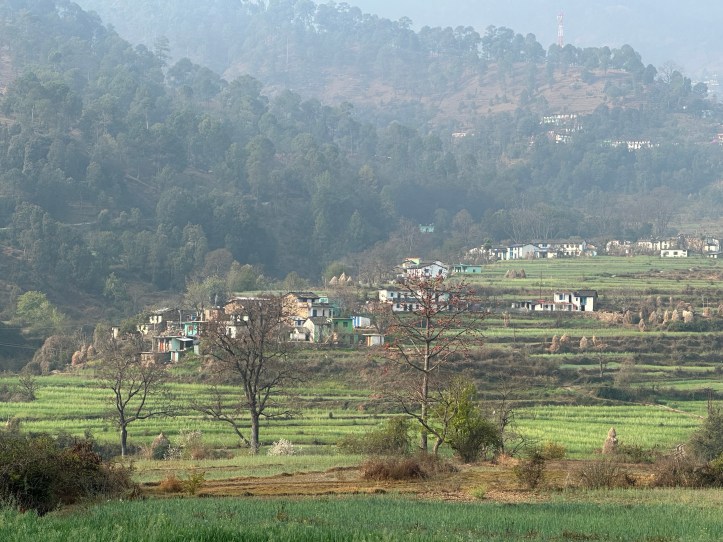
As I walk through the narrow lanes leading to my village, I feel as if everything has been curated to my taste and senses. The early morning air, carrying a touch of sweet tenor, gently caresses the skin on my bare hands. I can hear the sound of it too, very soft, as it brushes against the needles of the pine trees, making them sway gently. It is flowering time for chir pine trees, and soft green or light brown immature cones protrude upwards from each bark. They are everywhere around , just like the song of the long blue-tailed magpies that I can distinctly hear across the vast open valley. Houses lined in a cascading manner appear magnificent amidst the vast expanse of green fields, gently bathed in the morning rays. Holi is special in the mountains, and I can distinctly hear the muffled sound of a dhol (a local musical instrument) coming from some distant village in the Kamshyar valley (patti), as this area is known.
Our village still doesn’t have a road connectivity. The nearest roadhead is roughly a kilometre away. From there, you scale down a hill, cross a meandering rivulet (called Madoriya), enter a vast open field of paddy and wheat that sways with the onset of intermittent breezes, then climb a zigzag path dotted with trees of all kinds, and eventually arrive at the courtyard where our house stands.
What does a typical Kumaoni house consist of?
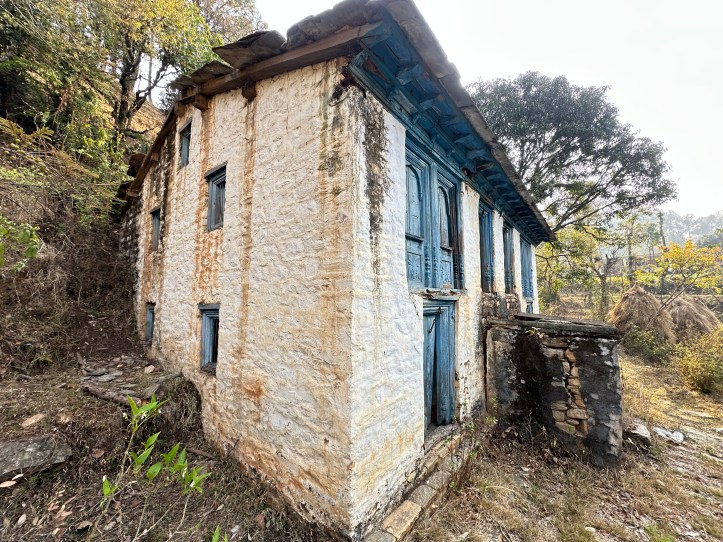
Kumaoni houses have traditionally been built using locally sourced material, including stone, wood and mud. The roofs have a slate-like design and are made of locally available stone called “Paather”. Their sloping structure prevent water or snow accumulation. Nestled at an altitude of 1,290 metres, Bheta village once experienced regular snowfall during winter, as my father recalls. However, it hasn’t snowed here in many years, another sign of climate change taking its toll.


A typical Kumauni house has a two- or three-storey layout. The ground floor, locally called ” Goth” ,is used for sheltering cattle and storing grain. The upper floor consists of living quarters, a wood-fired kitchen, a common space for sitting and chatting, and resting areas. Where applicable, an additional upper deck also includes bedrooms. The house is adorned with small windows featuring intricate wooden carvings.
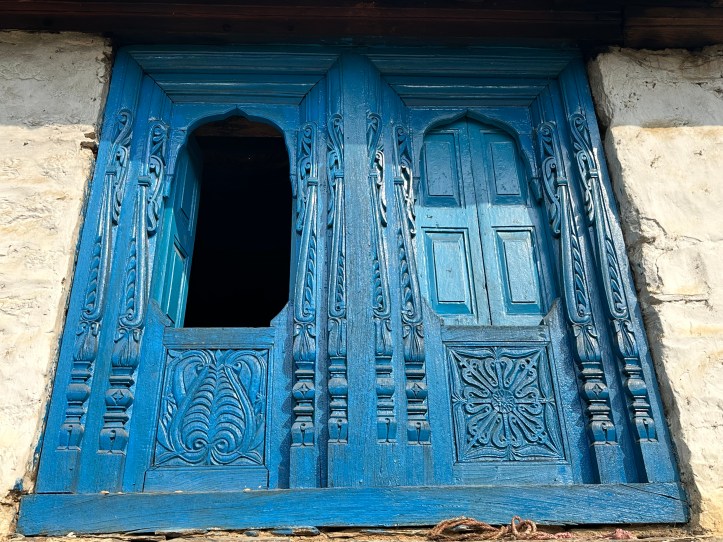
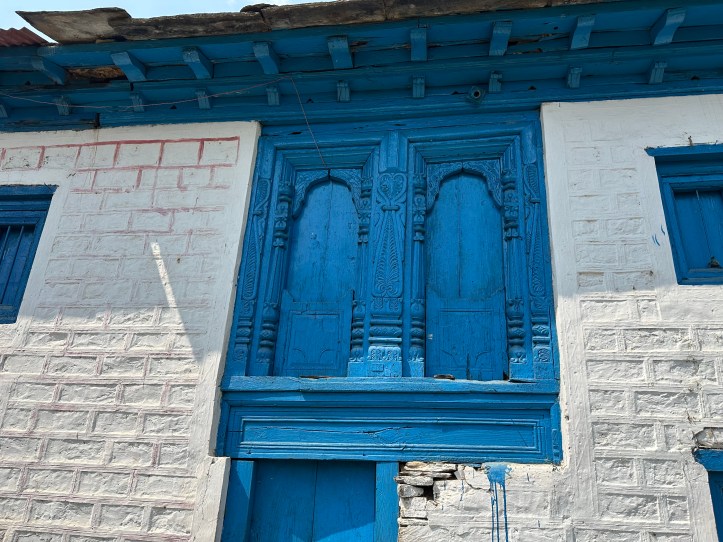
The entrance of a Kumaoni house has a distinctive layout. Two raised platforms appear on either side, with stairs in the middle leading to the upper storey. These platforms, made of stone slabs, are typically used for sitting, socializing, drying vegetables, and sorting grains. Another common feature of a Kumaoni house is a spacious courtyard- an open space in front of the house – where social gatherings and other household activities take place. The courtyard is ring-fenced by a low stone wall. The outer layer of the entire house is usually finished with white limestone (chuna) while the windows are typically painted blue or sometimes brown. Nowadays, skilled artisans capable of constructing such houses are hard to find, and the younger generation is less inclined toward this craft. As a result, modern houses are built using cement and bricks, following contemporary (linter) designs.
Why are people migrating from the hills? A sad reality

Our house above is a classic example of the saga of outward migration. My father moved in the early 1970s in pursuit of better education, and since then, he has been away, building his career and a comfortable life for his family. Such is the story of many others who seize any available opportunity for a more secure life – usually found far away in the plains, in cities and towns, hundreds of kilometres away.
The key issues leading to outward migration.
- Lack of economic opportunities and declining interest in labour-intensive agricultural work.
- Poor infrastructure – lack of quality schools, hospitals, and basic civic amenities
- The impact of climate change is also increasingly affecting people here
Despite the challenges, there have been visible and positive efforts from the Government side. Road connectivity has significantly improved, and except for a few villages (like ours), roads have reached almost everywhere. Electricity and water supply, are now more accessible, making life easier for the residents.
However, despite these efforts, the exodus continues. The 2011 census reported around 1,050 villages in Uttarakhand with zero population, earning them the term ‘Ghost villages’. This is a worrying sign. A report by the Rural Development and Migration Prevention Commission of Uttarakhand (Uttarakhand Palayan Ayog) in 2023 highlighted that between 2018 and 2022, approximately 3.3 lakh people migrated from various parts of the state, while the majority coming from the hills. The report categorizes this migration into temporary and permanent outward migration. While the numbers may continue to be debated, the real challenge lies in addressing the structural gaps that create a stark development divide between the plains and the hills.
However, not everything is melancholic. There are inspiring stories and initiatives that are successfully creating sustainable livelihood opportunities in the hills. Not far from my village, two such remarkable initiatives are making a significant impact by enabling employment for many.
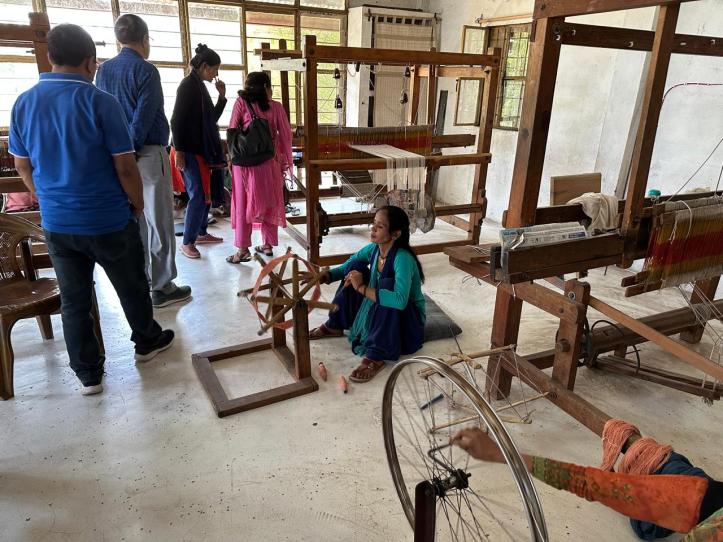
Initiative 1 (Avani) – is an apparel cooperative (run by Rashmi Bharti and Rajnish Jain) that is supporting hundreds of artisans from the neighbouring villages of Berinag. They not only provide sustainable livelihoods through textile production but also work on bio-energy production utilizing pine needles as a raw material for clear energy solutions. https://avani-kumaon.org/
Initiative 2 (Berinag Tea) – Located in Nayal village , about 30 kms from Berinag town, Parvatiya Chai Utpadan Swayat Sahakarta is a cooperative run by Mr. Vinod Karki and many other farmers. Berinag tea had a rich history when it was introduced by the British in the late 19th century. Over the years, it died a natural death, however, in 2011, Mr. Vinod Karki initiated a revival of this once sought-after tea, acclaimed for its aroma and taste. The initiative is now successfully supporting numerous smallholding farmers in the area. https://berinagtea.in/

While heading back from the village, my eyes stumbled upon a wire where a little sparrow was perched, chattering away, with a thin and delicate pine needle tucked under its beak. It was likely carrying it to build a nest for itself. At that moment, I realized that houses are still being built here—needle by needle, beak by beak—by these tiny creatures who continue to call my village their home. Not all is lost.
I hope you enjoyed reading this post.
References
- ToI article on the interim report of Uttarakhand Palayan Aayog – https://timesofindia.indiatimes.com/city/dehradun/migration-panel-data-present-opposite-views/articleshow/98529436.cms
- Avani – berinag based apparel cooperative – https://yourstory.com/2017/11/avani-artifact-kumaon
- Parvatiya Chai Utpadan Swayat Sahakarta (Berinag Tea) – https://timesofindia.indiatimes.com/city/dehradun/remote-village-in-ukhand-turns-barren-land-into-tea-gardens/articleshow/88015657.cms
 Travel diaries from Uttarakhand
Hello there, I recently came across your blog, nice to find someone who is truly exploring Uttarakhand and providing valuable information backed by thorough research. It’s always a pleasure to read such well-documented journeys. I wanted to know about Baijnath barrage in Bageshwar, could you please provide some information about it or any links.
Looking forward to your insights.
LikeLiked by 1 person
Thank you for the appreciation. I am glad you enjoyed the write-ups. As for Baijnath , it has been been very long since I last visited and I wasn’t much into blogging then. I may not have concrete information at this stage. But the temple complex is a fine art work built during the Katyuri period. So roughly 9th/10th century until about early 12th. Gomti river flows here so the water wud likely be drawn from it. I hope I visit here soon and document it properly.
LikeLike