
Last year, during Holy Easter week, on Good Friday, a notable incident occurred in the picturesque town of Harsil, nestled in the western Garhwal Himalayas. Harsil is a charming destination along the route to Gangotri, located about 25 kms away. Through this beautiful valley meanders the holy Bhagirathi River, surrounded by towering cliffs laced with thick deodar trees on both sides. Many of these cliffs are snow-covered year-round.

Within this enchanting landscape, in the heart of the small yet bustling town of Harsil, lies a Govt. run hotel called Garhwal Mandal Vikas Nigam (GMVN – Harsil). When I visited the area a few weeks later (after the incident took place), I learned firsthand about the event that had unfolded.
It was a bright, sunny April afternoon, with the snow-capped mountains shimmering under the sun’s golden rays. The mountain slopes presented themselves in distinct green texture, probably affected by the recent spell of showers, which are a regular affair in such altitudes. A gentle breeze swept through the area, and the tumbling waters of the Bhagirathi, as visible from the porch of the GMVN hotel, created a soothing rhythm that blended with the other sounds of nature. It was the ideal day, and the guests at the hotel were fully immersed in the experience. It was the perfect extended weekend they could have hoped for.
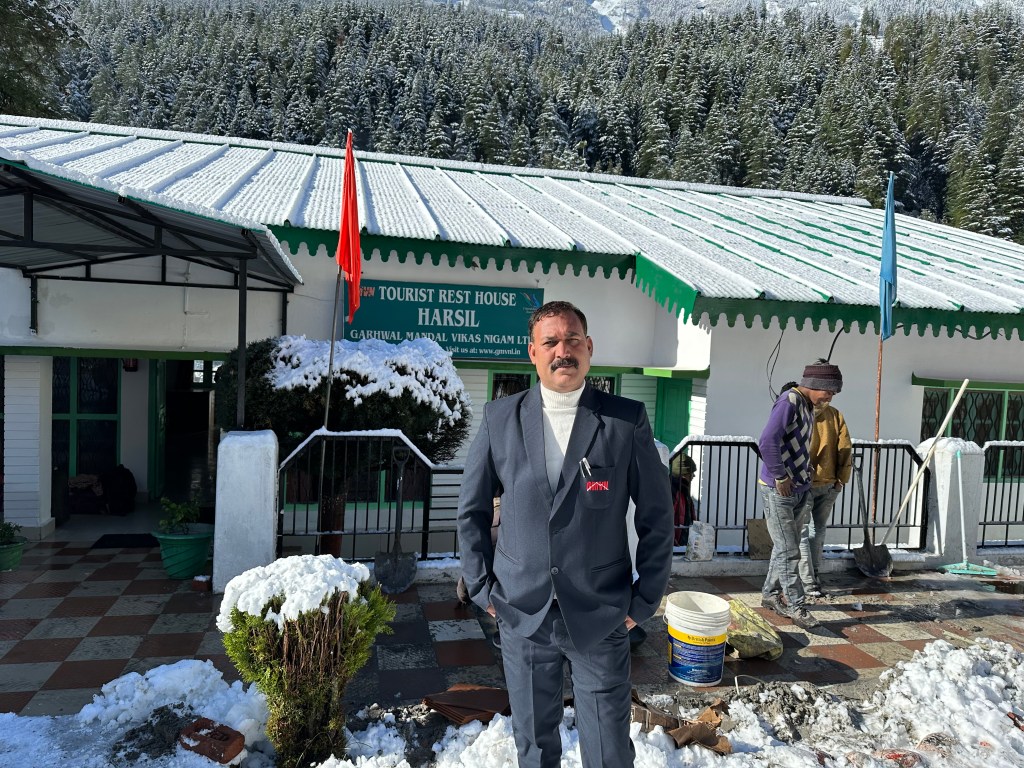
The Manager of the property, Sushil Dimri, was busy with guest check-ins and check-outs, along with routine procurement and maintenance tasks, all in preparation for the upcoming Char Dham yatra season. He was comfortably seated in a small office at the front of the property complex. Since it was a long weekend, his family was visiting him in Harsil. His two young boys, filled with excitement, wanted to make the most of their holidays and the spotless weather. They were playing cricket when they spotted a large, multi-coloured bird perched in the corner. Instantly captivated by its stunning appearance, they convinced themselves of having spotted a peacock. The younger of the two, hurried back to his father to convey him their observation and requested him to come outside. Sushil wasn’t convinced enough but he scrambled along with his kids to have a look at the creature.

Sushil instantly recognized it as Himalayan Monal, the state bird of Uttarakhand, and native to this high-altitude region. It is not easily sighted, as it is shy of humans and typically stays hidden in thick shrubs or dense undergrowth. Often on my treks to such altitudes, I hear the Monal’s call, a series of loud and clear whistles, but rarely have I spotted one. Therefore, its presence in a hotel compound, remaining unmoving was certainly strange for Sushil.
About Himalayan Monal
The male Himalayan Monal is known for its striking and vibrant plumage covering all the vivid colors of rainbow. It has a distinct metallic green head and a distinctive crest of the same color, a blue colored back, green shoulders, red neck and a typical orangish trail. Monal is a high-altitude bird usually found in altitudes between 2,500 – 4,500 metres above sea level.
Himalayan Monal has historically faced instances of hunting and were once considered as ‘game birds’, poached mainly for food and for décor items in the hills. In the past, feathers of the male monals have been used in the traditional Pahadi caps. But all these practices are completely prohibited now, and one is liable for legal action for killing of Monal. Sushil, well knowing that he can’t neglect the presence of the bird in the compound, decided to take things under control. He carefully and tenderly picked up the bird to check if it had any injury marks. Nothing was visible from the outside, but the bird was under stress.
If not humans, what could be possible predators for Monal?
In these high mountains, there are three giant birds that possibly hunt Monals and other birds to feed themselves:
Himalayan Golden Eagle– It is known for its impressive size and powerful predatory abilities, found in the Himalayan region.Himalayan Griffon– a giant vulture often seen soaring high in the sky in these high mountains.Bearded Vulture– these are primarily scavengers but also prey on small animals.
While we aren’t quite clear which of the above could have chased this particular monal, but it was likely that monal was been chased for a kill by one of these.

Sushil knew he couldn’t leave the bird on its own and decided to quickly inform the local police, whose officials immediately rushed to the scene to assess the situation. The police then notified the local forest check post, and their officers then took control of the bird. Sushil explained that the forest officials examined the bird for any injury marks and ensured it was able to fly in the neighbouring forested area by that evening.
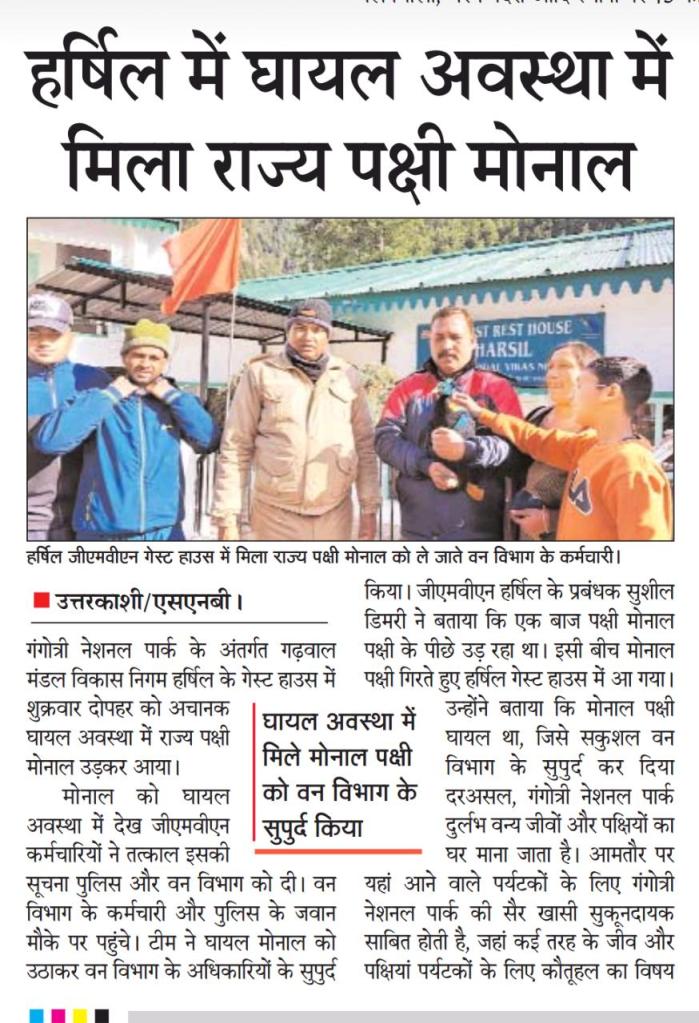
It’s important to acknowledge Sushil’s kind efforts and the prompt action by the police and forest officials. This heroic act caught the attention of media, and many channels and newspapers reached out to Sushil to capture his deed. The then district magistrate (DM) of Uttarkashi also called Sushil to congratulate him on his nobel act.
Sushil continuous to serve as the manager of GMVN Harsil hotel, always greeting visitors with a wide smile and a pleasing personality.
This post aims to celebrate the people of Uttarakhand and their noteworthy deeds.
Planning a visit to Harsil or further to the Gangotri National Park?
Harsil is a hidden gem in Uttarakhand, a charming little town where nature flourishes. There are numerous options for exploration, including short hikes or village walks. For more information on Harsil, check out my dedicated post on Harsil (click here).
You can also travel a bit further to pay your respects to Goddess Ganga at Gangotri located roughly 25 kms away. Alternatively, visit Gangotri National Park, renowned for its rugged terrain, towering peaks, and pristine glaciers. Consider trekking to Gaumukh to see the source of the Holy Ganga River. If you’re interested in 19th-century history, look for traces of Pahadi Wilson in the nearby Mukhba village or search for a brass coin he minted (check out my article on Pahadi Wilson or the Raja of Harsil, click here).
Can I tell you a secret about Harsil ? – Time seemingly stands still here and the residents have perhaps eternally surrendered themselves to the soothing embrace of silence.
 Travel diaries from Uttarakhand
What a pretty bird! Many thanks to Mr. Dimri’s prompt action in saving the gorgeous bird. I’ve once seen Himalayan Monal, just fleeting glance and from quite a distance, and I’m craving to have a nice long sighting since. Thanks for this positive story, Saurabh 🙂
LikeLiked by 1 person