When I first heard about a group of high-altitude lakes in the Tehri district, I felt somewhat sceptical. Until then, I had never come across any significant alpine treks in Tehri barring a few such as Khatling. With a cluster of lakes in one area, my curiosity intensified, urging me to unravel this mystery. Unfortunately, the internet yielded scant information about this region, leaving me unsatisfied in my quest to find more.
As I gathered pieces of information from different sources including locals from the area, I got more and more excited about uncovering this raw beauty. My zeal to undertake the hike intensified as I realized not many knew of this place barring the local villages and shepherds.

On a weekend in April, I decided to undertake this trek. Early in the morning, before the sun emerged into the blue sky from its slumber, I found myself on the road. I drove through the countryside, crossing Tehri Lake at Koti colony. The air grew cooler, traffic dwindled, and flora showered colors across my path. Spring is indeed a wonderful time to be in the hills. Every hill slope is spattered with hues, making the drive even more scenic.

The water levels of Tehri Lake were low, revealing parts of the old Tehri town appearing as small islands. I traversed over the dam and continued the drive alongside Bhilangna river enroute Ghansali town. From here, I left the main road and continued on a narrow (but well built) road that went alongside the Bal Ganga River. About 30 kilometers ahead, and one hour later, we arrived at Budha Kedar. We made a quick stop here, enjoying a simple meal of Dal and rice at a roadside joint. We relished the thick silence that permeated the holy town and admired the confluence of the Bal Ganga and Dharam Ganga rivers.

With my stomach full, it was time to cover the final stretch of the drive until Ghaniyalsaud, just before the major village of Trituna. I parked the vehicle here and immediately commenced the hike at about 2:30 PM.
In this remote region, as far as my eyes could scan, all I could see was a vast expanse of lush green forests scattered over tall cliffs. And somewhere here, were the 3 lakes shrouded from the wary eyes of the people. These lakes are a. Manjhaar tal , b. Jaraal Tal and c. Mahasar Tal.

Mahasar Tal, being the biggest of the three, is accessible via a trek of about 8 kms (one-way), and it was the one I chose for the hike. The initial stretch of 1 km was of an easy grade, with a clearly laid-out path and an easy ascent. Thick forests provided relief from the burning afternoon sun, and villages far and wide appeared as tiny sparks dotting the green mountain slopes. The scenery gave me the desired kick to continue our journey into the wild. Soon, I arrived at a temporary shed (locally called Channi) where some human activity was visible. I filled my water bottle here and continued the ascent into the thick forests, gaining altitude with each crunch of the dried leaves under my heavy boots. This section was a steep incline and continued to be so until I arrived at the top of this hill, roughly 5 kms into the hike.

Once at the top, the view ahead was obscured by a thick blanket of clouds hovering above the hills. In the hills, weather dances to its own tune. One moment, the sun reigns supreme, the next, a downpour of gigantic proportions takes centre stage. As I descended from the top, and a few steps into the march, it began to pour, though it started initially as a gentle drizzle. The air became heavy and cold, and it made deep noise, hitting our faces hard while I continued to trudge in the opposite direction. The landscape opened up into a grassland scattered with numerous sheep. Despite the ensuing cold, it felt wonderful. I spotted a tent and a small fire that the herders had set up. They offered me a cup of black tea despite the gentle raindrops attempting to drench me.

The rain continued, and so did my walk. I kept my spirits high, constantly reminded by the guide that we were not far from our destination, and that the remainder of the stretch would be a comfortable one. Just as darkness set in, with the relentless rain pouring down, we finally arrived at our base. Nothing was visible, and we had to light our torch to navigate our path around the outer boundary of the lake. Temporary huts stood at one corner of the open area, and soon I was guided to a shed which would be my room for the night. It was basic by any means, but I had no complaints. The rain continued to beat against the tin roof above. Our guide cum cook prepared a simple meal of dal and rice, and given a hectic day I had, it didn’t take long for me to drift off to sleep.

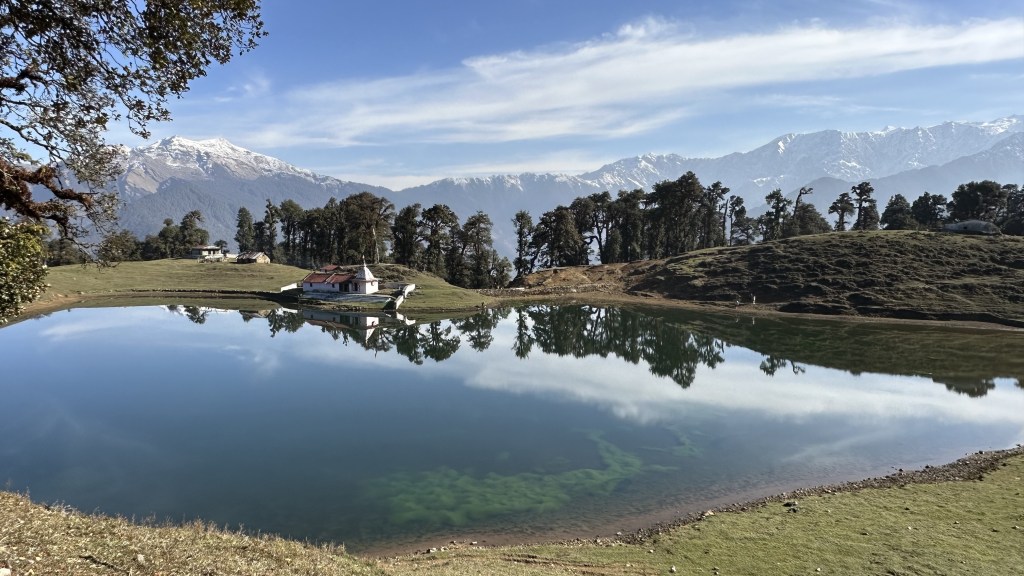
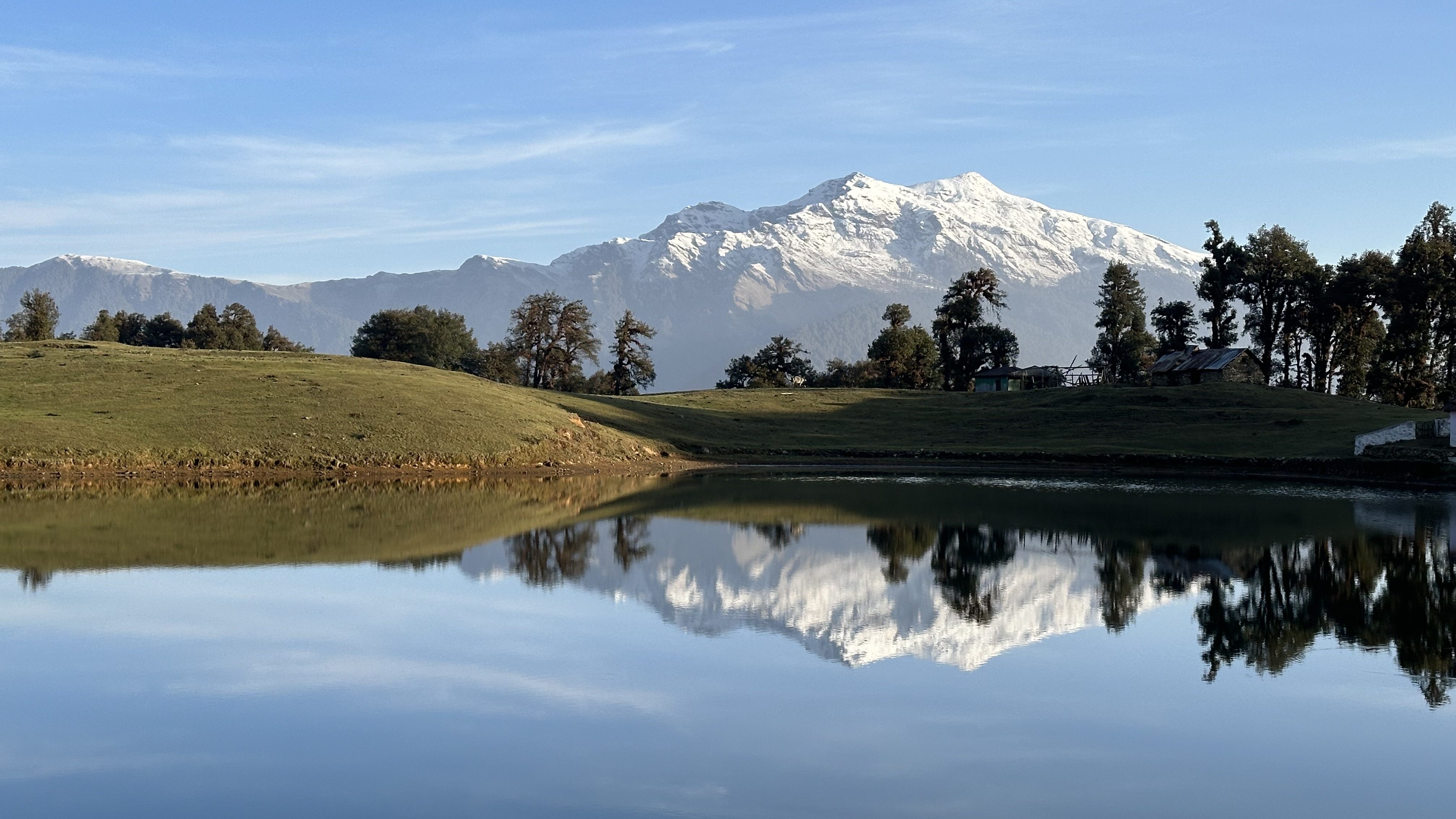
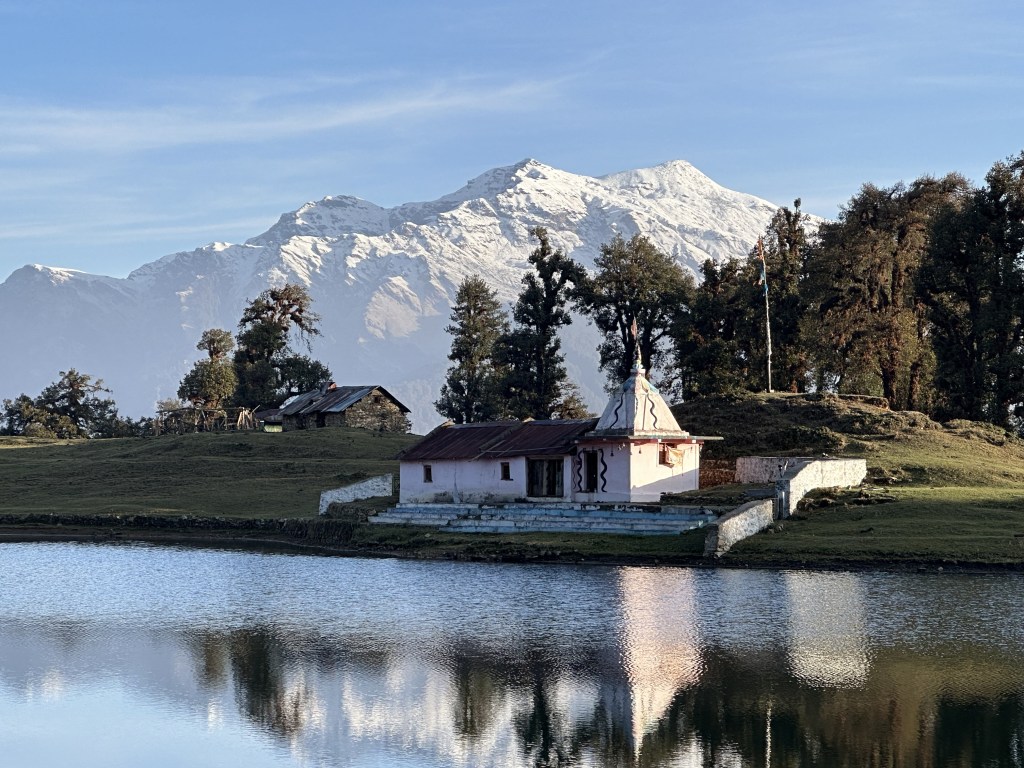
The next morning, as is often the case in the hills, the sky held no trace of clouds. I couldn’t have asked for a better sight. The landscape seemed surreal and otherworldly. The lake, embraced by the rising sun, and the distant hills, their peaks dusted with fresh snow, along with a small temple dedicated to Mahasar Nag at one end, left me captivated and filled with awe. I wandered around the lake, snapping hundreds of pictures from various angles, enjoying the morning birds as they dove into the river, showcasing their acrobatic skills. I relished the silence, which continued unabated, undisturbed by any external interference. May this place remain a hidden secret in Tehri, shielded from the prying eyes of humanity.
About Mahasar Nag Temple

At one end of the lake stands a modest temple dedicated to Mahasar Nag, a revered local deity believed to be an incarnation of Lord Vishnu. The people of the region hold deep reverence for this deity, offering prayers and seeking blessings for bountiful rains to nourish their crops and to avert any disasters. Normally housed in a temple in Bisan village, a few kilometers beyond Budha Kedar, the custodians of the deity and its palanquin are the priests of the Bhatt family from Bisan. Annually, during Ganga Dusshera, they transport the palanquin to this temple, where the deity is ceremonially bathed in the sacred waters and the holy water is then carried back to their respective villages. Additionally, a small fair is organized at this location on the same day.

After paying my obeisance at the Nag temple, I immersed myself in the surroundings as the sun gathered intensity, scattering its warmth and brightness across the vast expanse. The richness of the green grass in the meadows, the towering Oak and Rhododendron trees, and the wildflowers, such as Himalayan Gentian and Floppy Himalayan Anemone, bursting in hues of multiple colors- I absorbed it all. Just a few steps ahead of Mahasar Tal, there’s another small lake. At around 9 AM, after a quick breakfast of hot tea and Maggi, it was time to begin the return journey, and onwards to Dehradun.


It took us roughly 3.5 hours to descend the zig-zag path down the mountains. Upon reaching Ghaniyalsaud, we bid farewell to our guide and began our drive back. Along the way, I made a brief stop at Bishan village, home to the Nag deity’s temple. Unfortunately, the temple was closed when I arrived there. I also briefly visited Budha / Boodha Kedar temple, a historical site believed to have been visited by the Pandava brothers during their quest to meet Lord Shiva.
This brings us to the end of an interesting weekend hike.
The pointers below will be helpful to those who wish to undertake this trek.
Distance from base | 8 kms (one-way) from Ghaniyalsaud or Titruna village. Google Map link |
Infrastructure readiness (on the trek route) | This is not a known trek and therefore one will not find any shop or hotel on the way. You will have to carry everything from the base itself and perhaps take a guide and other support |
Altitude of Mahasar Tal | 2900 metres (9500 ft) |
Himalayan peaks visible from Mahasar Tal | Kushkalyan Top (3798 metres), Jaonli Peak (6600 metres) , Shastru Peak ( 5126 metres) |
Other treks further ahead of Mahasar Tal | Mundi Top , Kyarki Top , Arjun ki Kursi, Sahastra Tal. From Titruna via Belak one can even cross over to Bhatwari, on Uttarkashi side which will be a 2 day trek |
Distance and time | Dehradun – Ghaniyalsaud :– 180 Kms | 6 hours | Drive Ghaniyalsaud – Mahasar Tal :– 8 kms | 4 hours | Trek (uphill) Mahasar Tal – Ghaniyalsaud :– 8 kms | 3.5 hours | Trek (downhill) |
 Travel diaries from Uttarakhand
This is an amazing trek sir, you are lucky that you have got this good opportunity.
LikeLiked by 1 person